Family Law
Author:
Getting Married Abroad as a Turkish Citizen: What Is a Certificate of Capacity to Marry and How Do You Get One?
Getting Married Abroad as a Turkish Citizen: What Is a Certificate of Capacity to Marry and How Do You Get One?
Getting married abroad is a significant life decision — but behind the celebration lies a paperwork process that many people underestimate. One of the most commonly misunderstood documents in this process is the multilingual civil registry certificate, officially known as the Certificate of Capacity to Marry (Evlenme Ehliyet Belgesi in Turkish).
If you are reading this, chances are you have encountered at least one of the following questions:
"I am getting married in Germany — what document do I need from Turkey?"
"The civil registry office mentioned a 'multilingual extract' but it is not clear what that actually means."
"Will foreign authorities accept this document directly, without additional verification?"
This article addresses these questions and outlines the aspects of the process that require careful attention.
What Is a Certificate of Capacity to Marry?
A Certificate of Capacity to Marry is an official document certifying that a person has no legal impediment to marriage under the laws of their home country — in other words, that they are legally eligible to marry.
In Turkey, the certificate is issued by local civil registry offices (nüfus müdürlüğü) and is valid for six months from the date of issue. By presenting this document, the couple can avoid the need for foreign authorities to independently verify the person's marital status with Turkish institutions.
The legal foundation for this certificate is the Convention on the Issue of a Certificate of Capacity to Marry, signed in Munich on 5 September 1980 and entered into force for Turkey on 1 June 1989.
Which Countries Accept This Certificate?
The following countries are parties to this international convention:
Germany
Austria
Belgium
Spain
France (signatory, but has not ratified — see note below)
Greece
Italy
Luxembourg
Netherlands
Portugal
Switzerland
Turkey
Moldova
Civil registry authorities in these countries accept the Turkish Certificate of Capacity to Marry directly, without requiring apostille or additional legalisation. This represents a significant procedural advantage.
Important Note: France signed the convention but has not ratified it, meaning a different procedure may apply for marriages in France. More broadly, the list of signatory states and the conditions of application may change over time. It is advisable to verify current requirements with the relevant foreign authority or a qualified legal practitioner before proceeding.
What Does the Certificate Contain?
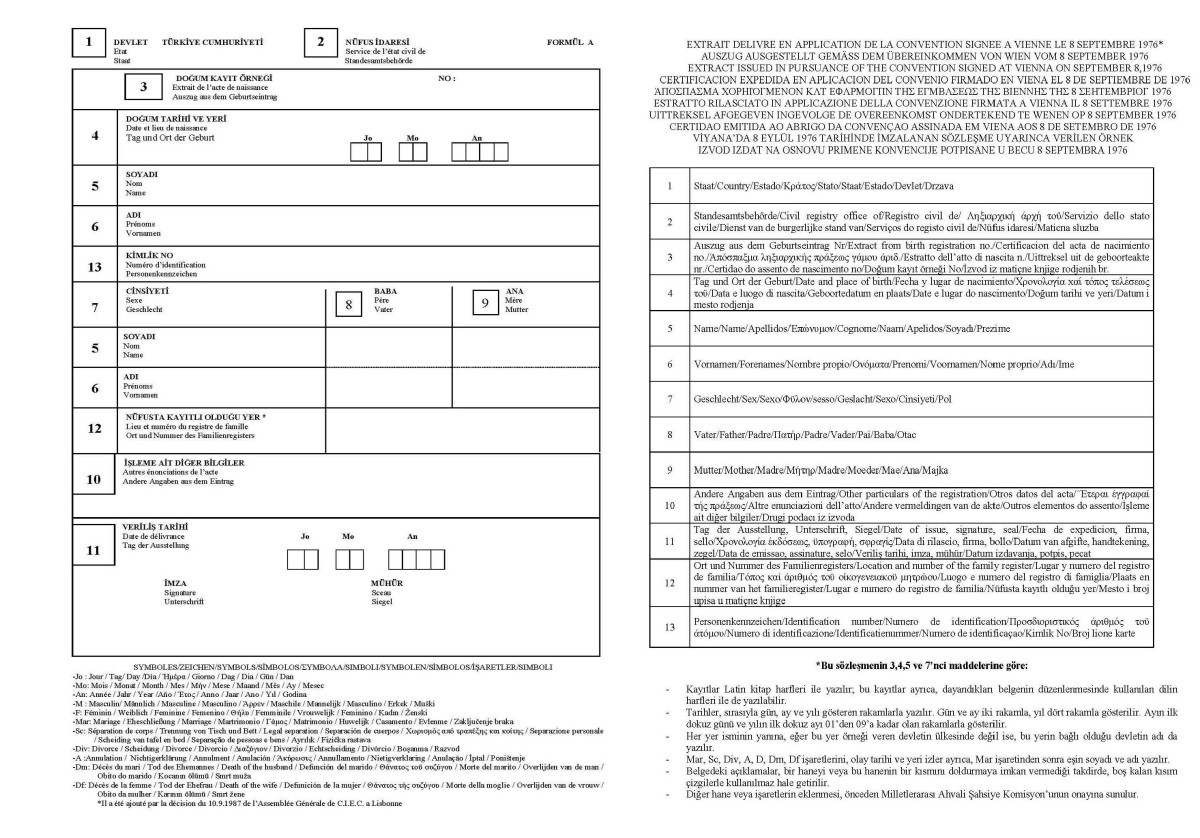
The certificate follows a standardised format and is printed in at least two languages — Turkish and French — with German also commonly included. Symbols and their multilingual equivalents appear on the reverse side of the document.
Fields Included in the Certificate
Field | Details |
|---|---|
Surname / Given Names | Written in Latin print letters |
Sex | M (Male) / F (Female) |
Nationality | Using international vehicle registration codes (e.g. TR for Turkey) |
Date and Place of Birth | Day/Month/Year format |
Habitual Residence | Place of ordinary residence |
Civil Registry Location and Number | Turkish population register reference |
Previous Marriage | If applicable: dissolved by death (D), divorce (DIV), annulment (A), or absence (ABS) |
Intended Spouse Information | Same fields repeated for the other party |
How Are Dates Written?
Dates are recorded using the following abbreviations:
Jo = Day (Jour / Tag / Day)
Mo = Month (Mois / Monat / Month)
An = Year (Année / Jahr / Year)
Single-digit days and months are written with a leading zero: 5 June → 05 06.
Refugees and Stateless Persons
Refugees are indicated with the symbol REF
Stateless persons are indicated with the symbol APA
Under the convention, refugees and stateless persons residing in a contracting state are treated as nationals of that state for the purposes of this certificate.
Who Can Obtain This Certificate and How?
The certificate is available to Turkish citizens planning to marry abroad. The process is as follows:
Apply to the civil registry office (nüfus müdürlüğü) in your place of residence.
The office verifies that there is no legal impediment to your marriage.
Information about your intended spouse is also recorded in the document.
The certificate is issued and handed over with a six-month validity period.
If any field cannot be completed — for example, because certain details of the intended spouse are unavailable — that section is crossed out. This does not affect the document's validity.
What Can Complicate the Process?
While the procedure appears straightforward in theory, several circumstances can make it considerably more complex in practice.
1. Dissolution of a Previous Marriage
If either party has been married before, proof that the previous marriage has legally ended is required. Depending on the circumstances, this may involve a divorce decree, death certificate, or annulment order — all of which must be in order for both Turkish and foreign authorities.
In some countries, a foreign divorce judgment may need to be formally recognised before it can be relied upon. This is a separate legal procedure known as recognition and enforcement of foreign court decisions (tanıma ve tenfiz).
2. Mixed-Nationality Marriages
In marriages where one party is a foreign national, both parties are generally required to demonstrate their capacity to marry under their respective national laws. This means the Turkish Certificate of Capacity to Marry will typically need to be accompanied by an equivalent document from the foreign spouse's country.
3. Translation and Apostille Requirements
While the certificate is accepted directly between contracting states, marriages taking place in countries that are not party to the convention may require an apostille certification and/or a notarised translation of the document.
4. Registration of a Foreign Marriage in Turkey
After getting married abroad, the marriage must be registered in the Turkish civil registry. This is a separate step, and errors or omissions at this stage can create significant legal complications down the line — particularly in matters involving inheritance, property, or parental rights.
Why Does This Matter for Inheritance Law?
The Certificate of Capacity to Marry and the process surrounding marriages conducted abroad are not merely administrative matters. They carry direct implications under family and inheritance law.
If a marriage performed abroad is not properly registered in Turkey, it may later be challenged in inheritance proceedings. For a surviving spouse to claim inheritance rights under Turkish law, the marriage must be legally valid and recorded within the Turkish civil registry system.
Common issues that arise in practice include:
Challenges to spousal status in inheritance proceedings where the marriage was conducted abroad but never registered in Turkey.
Disputes arising from a prior marriage that was not formally dissolved before a new marriage was entered into.
Documentation gaps in inheritance cases involving Turkish real estate held by multinational families.
Establishing the marriage correctly from the outset — and ensuring it is properly documented and registered — is therefore as important as the marriage itself from a legal security standpoint.
When Is Legal Assistance Advisable?
In many cases, obtaining a Certificate of Capacity to Marry can be handled directly through the civil registry office without legal intervention. However, a legal assessment is recommended in the following situations:
A previous marriage was dissolved by a foreign court
The intended spouse is a foreign national from a country that is not party to the convention
The marriage has implications for inheritance, title deed, or custody matters in Turkey
A marriage conducted abroad has never been registered in Turkey
In such circumstances, consulting an attorney experienced in family and inheritance law can help prevent disputes from arising at a later stage.
Conclusion: A Straightforward Document With Far-Reaching Implications
The Certificate of Capacity to Marry may appear to be a routine piece of paperwork. Behind it, however, lies an international convention, a multilingual standardised format, and connections to inheritance and family law that are often underestimated.
Managing the process correctly from the beginning is the most effective way to avoid serious legal complications later.
For questions or enquiries on this topic, nisanci.av.tr can be contacted directly.
Disclamer
What exactly is a Certificate of Capacity to Marry?
t is an official document issued by a Turkish civil registry office confirming that a Turkish citizen has no legal impediment to marriage — in other words, that they are legally free to marry. It is valid for six months from the date of issue.
Will every country accept this certificate without extra steps?
No. Only countries party to the 1980 Munich Convention — including Germany, Austria, Belgium, Spain, Greece, Italy, the Netherlands, Portugal, Switzerland, and Moldova — accept it directly without apostille or further legalisation. Outside these countries, additional certification may be required.
What happens if I was married before?
You will need to prove that any previous marriage has legally ended, whether by divorce decree, death certificate, or annulment order. If the earlier marriage ended through a foreign divorce, that decree may first need to be formally recognised in Turkey before it can be relied upon.
Does this certificate affect inheritance rights later on?
Yes, indirectly. If a marriage performed abroad is never registered in the Turkish civil registry, the surviving spouse's inheritance rights under Turkish law can later be challenged, particularly in estates involving Turkish real estate.
Do I need a lawyer just to get this certificate?
For a straightforward application, most people can handle it directly through the civil registry office. Legal advice becomes advisable where a previous marriage was dissolved abroad, the intended spouse is from a non-member country, or the marriage has implications for property or custody matters in Turkey.
More Insights

Sep 24, 2026
The Parentela System: Statutory Heirs and Inheritance Shares under Turkish Law
How the Turkish Civil Code (Arts. 495–501) determines statutory heirs and their shares: the parentela system, representation, the surviving spouse, adopted children and the State, with a family-tree diagram for every scenario and Court of Cassation case law.

Sep 21, 2026
Deemed Renunciation of Inheritance in Turkey | Article 605 TMK
Does an insolvent estate automatically protect heirs in Turkey? We examine the conditions for deemed renunciation of inheritance under Article 605/2 of the Turkish Civil Code, the burden of proof, and the relevant Court of Cassation rulings.

Sep 16, 2026
What Law Applies to Your Inheritance in Turkey? Forced Heirship for Foreign Nationals
If you own property in Turkey, or stand to inherit from a Turkish national, you may be wondering which country's inheritance law actually applies. Here's what Turkish private international law and the forced heirship rules say.